Early January 2026
Stable structures
We began with the unglamorous bedrock everything else would stand on: a private, secure home for your work that you sign into and trust, and the first high-definition waveform you could scrub and study. And we made a rule on day one that has never changed — every feature stays open to everyone, limited only by storage. Anyone, any role, any reason. No gatekeeping, no hassle.
Late January 2026 - February 2026
Loudness you could trust
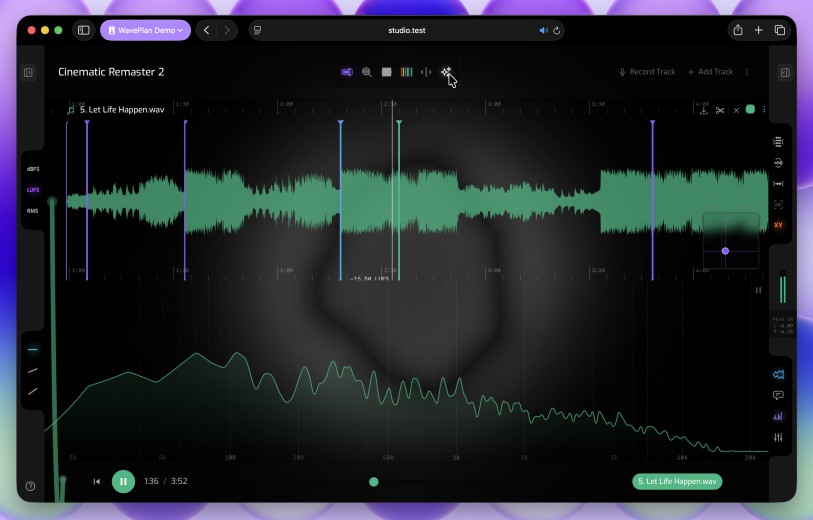
Loudness stopped being a guess. Meters followed the playhead in real time, dragging a selection revealed its loudness range, and the numbers gained a decimal place — finer truth, at a glance. For the first time you could judge a mix against a number you actually believed.
February 2026
Your private timeline
Planning Mode arrived: load tracks, trim to the regions that matter, and jot timecoded notes right on the playable waveform. A space that's yours alone, to analyse and shape ideas at your own pace — the moment WavePlan stopped being a viewer and became a place to think.
Early March 2026
A second way to see
The Frequency Analyzer gave you a real-time, high-resolution spectrum of whatever you were hearing — and a way to tilt it (flat, 3 dB/oct, 4.5 dB/oct) so you could judge spectral balance the way you actually hear it, on your monitors or on consumer playback. It became a note-taking surface too, so your thinking travels between what you see and what you hear. It also set the visual language everything after it would carry.
Early March 2026
Words on the timeline
The timeline became a place to think, not just to see: lyrics and notes snapped to time, ideas captured straight into a track, and annotations smart enough to keep themselves readable however dense they got.
Late March 2026
An aquarium for ideas
We gave the ideas panel a little life — a softly blurred waveform behind your fragments, and an aquarium that swims alongside your thinking. Useless, in the best way. A reminder that a tool you live in is allowed to have a heartbeat.
April 2026 - May 2026
A living canvas
The ideas panel grew up: scalable, interactive word boxes, a sparkling playhead, and a warm cathode glow. A place to think out loud, and to watch the fragments slowly arrange themselves into something.
Mid May 2026
A door for visitors
We opened a public door: an interactive demo and landing page where people could feel the planning workflow before committing to it. No sign-up wall, no sales pitch — just the tool, so you could decide for yourself.
May 2026
A face for the library
Cover art gave every file a face, and the demo grew hands-on stations so visitors could actually touch the tools. A library of waveforms became a library of records — something you could recognise at a glance.
May 2026
A smoother surface
The workspace got more fluid: panels that resize as one, a jog wheel for tactile scrubbing through audio, and selectable background visualizers to set the atmosphere. Small things, but they're the difference between using a tool and enjoying it.
May 2026 - Early June 2026
Annotations grow up
Annotation became a real discipline: markers imported straight from your WAVs, versions you could compare and merge, notes on the stereo field, and a workspace you could arrange to fit how you actually think.
June 2026
Cues and targets on the glass
We brought your notes and targets right onto the waveform and the meters — see song sections at a glance and mark loudness targets to compare against as you play. Everything you need to judge a mix, on the glass in front of you.
June 2026
Broadcast-grade metering
Metering grew up: live Momentary, Short-term, and Integrated loudness beside K-12, K-14, and K-20 scales, so you could judge a mix against broadcast, film, or classical targets. The workspace learned to follow your attention, and the whole surface was hardened against abuse.
Late June 2026
A workspace that remembers
The small things that make a tool feel like yours: colour that follows your mood, a sidebar and search that remember where you were, and a smoother planning workflow throughout. It stopped resetting you every time you came back.
July 2026
Your workspace, front and centre
WavePlan became the room you walk into: your planning dashboard greets you at login, an ambient screensaver carries your library, and your account gained a clean, considered way to close it. We'd rather you stay because you want to than because you're stuck.
July 2026
Billing and a front door
Annual billing arrived alongside monthly, and a proper public front door gave people a first look before they signed up. The unglamorous plumbing that turns a project into a service people can rely on.
August 2026
Looking after your account
When a subscription lapses, WavePlan verifies your account capacity and helps you resolve storage issues, so nothing is ever left hanging. The kind of care you only notice when it isn't there.
August 2026
A filesystem that gives back
We rebuilt storage from the ground up — a content-addressed filesystem that keeps one copy of each unique file and scales without slowing down. For you, that means the duplicates a working audio life accumulates (the same take in three plans, a master and its revisions, a reference you reuse) count once, and the space they would have wasted comes back to you. Alongside it: offsite backups you can actually download, and honest event tracking that keeps uploads sound.
Late August 2026
Staying in the loop
We wired the account events that matter into your inbox, so you hear about the important things without having to come looking. Quiet, reliable communication — the way it should be.
Mid September 2026
The foundation is solid
WavePlan 1.0 brings together everything the studio dream needed beneath it: your library in sync across your machines, every file versioned and recoverable, recordings analysed the moment they land, a library that stays fast however big it grows, storage you can see and control, and support that reaches us without leaving the app. The foundation is solid. Everything we build next stands on it.